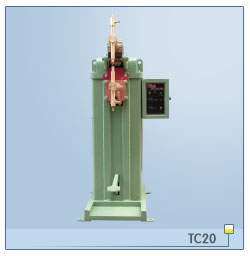
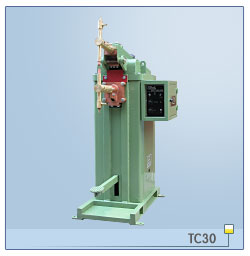
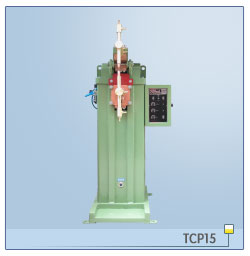
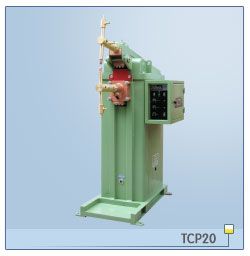
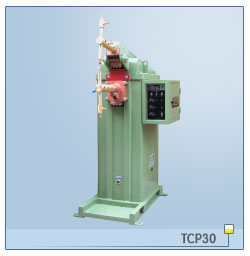
History: Spot welding was introduced
by Elihu Thomson in 1877 and came into use in the period
1900-1905. Since 1933, resistance spot welding has been
applied in a large industrial scale for the manufacturing
of household appliance, electrical contacts, relays,
lamp fixings and also in car body production.
Definition: Spot welding is a resistance welding process
in which overlapped sheets are joined by squeezing together
in electrodes which provide necessary heat for fusion
by conducting an electric current to produce localized
heat and force to join fused metal.
Principle: Spot welding works on principle of Joule
E=IR2 (E= Energy, I= Current, R= Resistance) a low volt
high current is passed through work which heats the
work that is clamped firmly between copper electrodes,
Where sheets are met to each other (R) is much more
than other contacts, Hence much heat is produced inside
work and it fuses work from inside, after a pre determined
time current is stopped then fused metal solidifies
and a proper joint build up under pressure of electrodes. |

























 128
128